
There is a specific sound that every Dark Romance reader recognizes instantly.
It isn’t the metallic rack of a 9mm slide. It isn’t the distant rumble of an armored engine idling in a rainy alley.
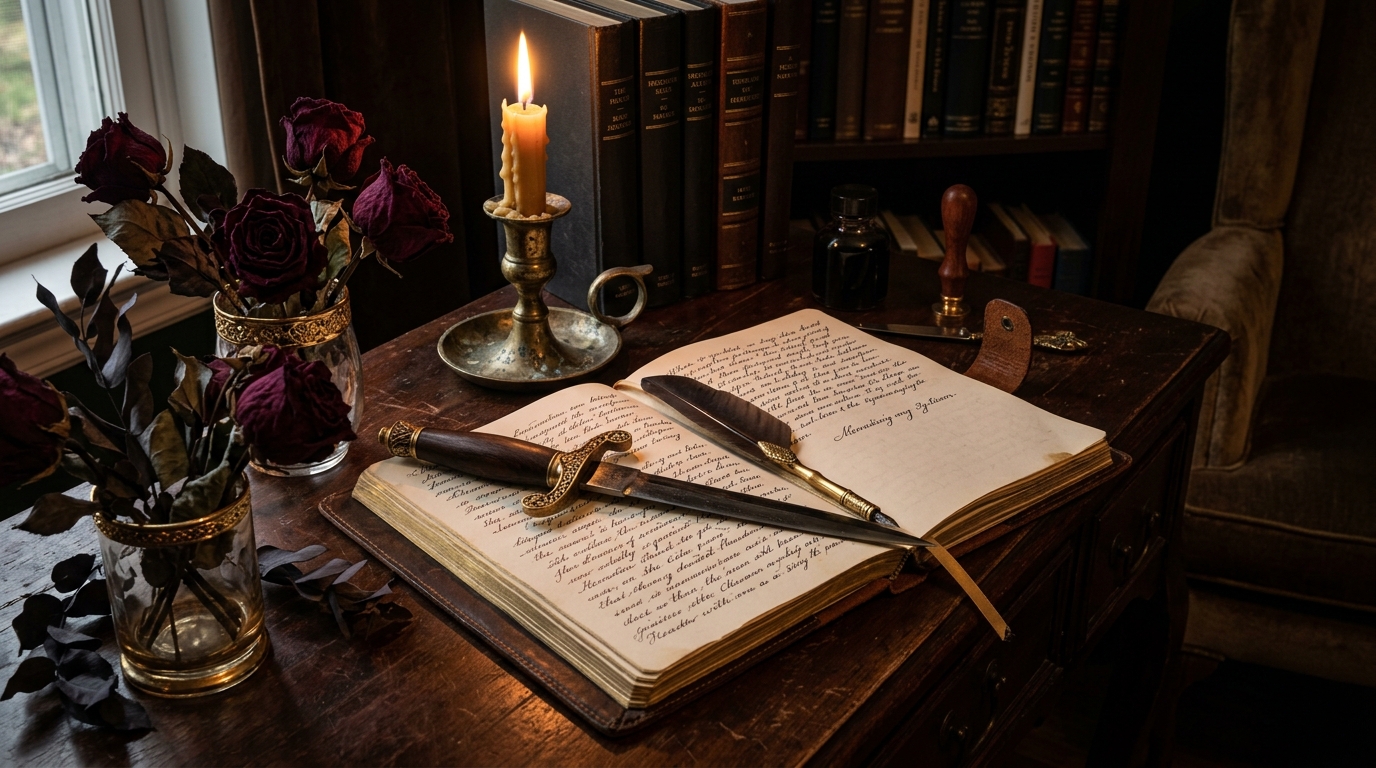
It is the hushed whisper of forged steel sliding out of its leather sheath.
A second later, your back hits the wood paneling of a dimly lit study or cold marble wall. A man’s forearm braces above your shoulder, and a chilling touch presses firmly into the angle of your jaw.
The flat of the blade glides upward, tilting your chin up with surgical precision until the razor-sharp tip rests directly over your carotid artery.
Right where your pulse pounds against your skin.
The man holding you hostage barely breathes. His dark eyes burn inches from yours. He could press forward a fraction of an inch and end your life.
Instead of screaming or begging, you hold his gaze. You inhale slowly, feeling the steel bite lightly into your skin. And in the pit of your stomach, what awakens is not panic: it is fire.
Welcome to the Knife-to-the-Throat Trope: the sharpest, most visceral, and most intoxicating foreplay in all of dark romance.
1. Close Quarters: Why Guns Fail as Romantic Foreplay
From a ballistic standpoint, a firearm is far more practical.
From a narrative and erotic standpoint, a gun is a colossal failure.
Guns keep distance: you can pull a trigger from twenty feet away without meeting someone’s eyes, without catching their scent, without feeling their heat. It is an impersonal, bureaucratic weapon.
A blade demands total, uncompromising proximity:
                  GUN VS. BLADE IN ROMANTIC TENSION

     THE HANDGUN (Distance & Detachment)       THE BLADE (Intimacy & Fire)
 ┌───────────────────────────┐             ┌───────────────────────────┐
 │ • Range: 15 to 30 feet    │             │ • Range: Inches away      │
 │ • Physical touch: None    │     VS      │ • Body flush against body │
 │ • Scent: Burnt powder     │             │ • Scent of cedar & leather│
 │ • Eye contact: Optional   │             │ • Locked, unblinking gaze │
 │ • Result: Execution       │             │ • Result: Foreplay        │
 └───────────────────────────┘             └───────────────────────────┘
To threaten someone with a knife, your breath must mingle with hers. You must hear the flutter of her eyelashes. Your chest must graze hers with every heartbeat.
The blade is not merely a weapon: it is an extension of steel fingers mapping out the flesh before claiming it.
2. Baring the Throat: The Heroine’s Defiant Dare
In animal behavior, a wolf baring its throat signals submissive surrender.
In Dark Romance, this gesture is brilliantly subverted: it becomes the pinnacle of defiance.
When the anti-hero presses steel beneath her throat, he expects tears, trembling, or pleading. That is what every enemy he interrogates does.
The dark romance heroine does the exact opposite:
- She lifts her chin higher.
- She tilts her head, deliberately offering her artery to the edge.
- She locks eyes with the killer with taunting audacity.
“— You're playing with your life, sweetheart. One twitch and you bleed.
 — Then do it. Press. Or put that blade away and admit you're more terrified of touching me than killing me.”
By refusing to cower, the heroine disarms the monster. She proves that pain does not intimidate her—and that in this duel of wills, he is the one losing control.
3. Sensory Shock: Freezing Steel on Burning Skin
Why is this trope so addictive? Because it hinges on unbelievable tactile contrast:
The Temperature Clash
Damascus steel is cold as stone. An adrenaline-flooded carotid is burning hot. The instant metal touches skin, an electric shock travels down the spine: pupils dilate, breath hitches, skin breaks into goosebumps.
The Transmitted Pulse
The most electrifying detail is acoustic and physical: because the tip rests on her carotid artery, the anti-hero physically feels her racing heartbeat humming through the hilt of his weapon.
He feels her pulse hammer at 130 beats per minute. And he knows it isn’t just terror: it is mutual, toxic fascination that neither of them can deny.
4. The Fall of the Blade: When the Hand Replaces the Steel
The climax of this sequence is always the same:
Faced with her insolent gaze, feeling her pulse race against his weapon, the anti-hero realizes his defeat. Killing her would be easy. But living without claiming her has become impossible.
Then comes the turning point:
- His grip loosens.
- The blade clatters to the floor or bites into the mahogany desk.
- And before she can even draw breath, his bare hand clamps down in the exact same spot.
His warm, scarred fingers wrap around her throat—not to suffocate, but to feel the thrum of her life beneath his palm. His thumb strokes her jawline. His mouth crashes down on hers with ravenous hunger.
The steel was only an excuse. The monster just needed to touch her.
5. Experience Julian Wolfe in Cruel Accords
In Cruel Accords — Volume 1: Under His Rule, high-stakes intimidation and lethal close-quarters tension define Julian Wolfe’s interactions with Elena Vance.
Start reading on Kindle Unlimited, and join the Zaria Vane VIP Club for free reading updates!