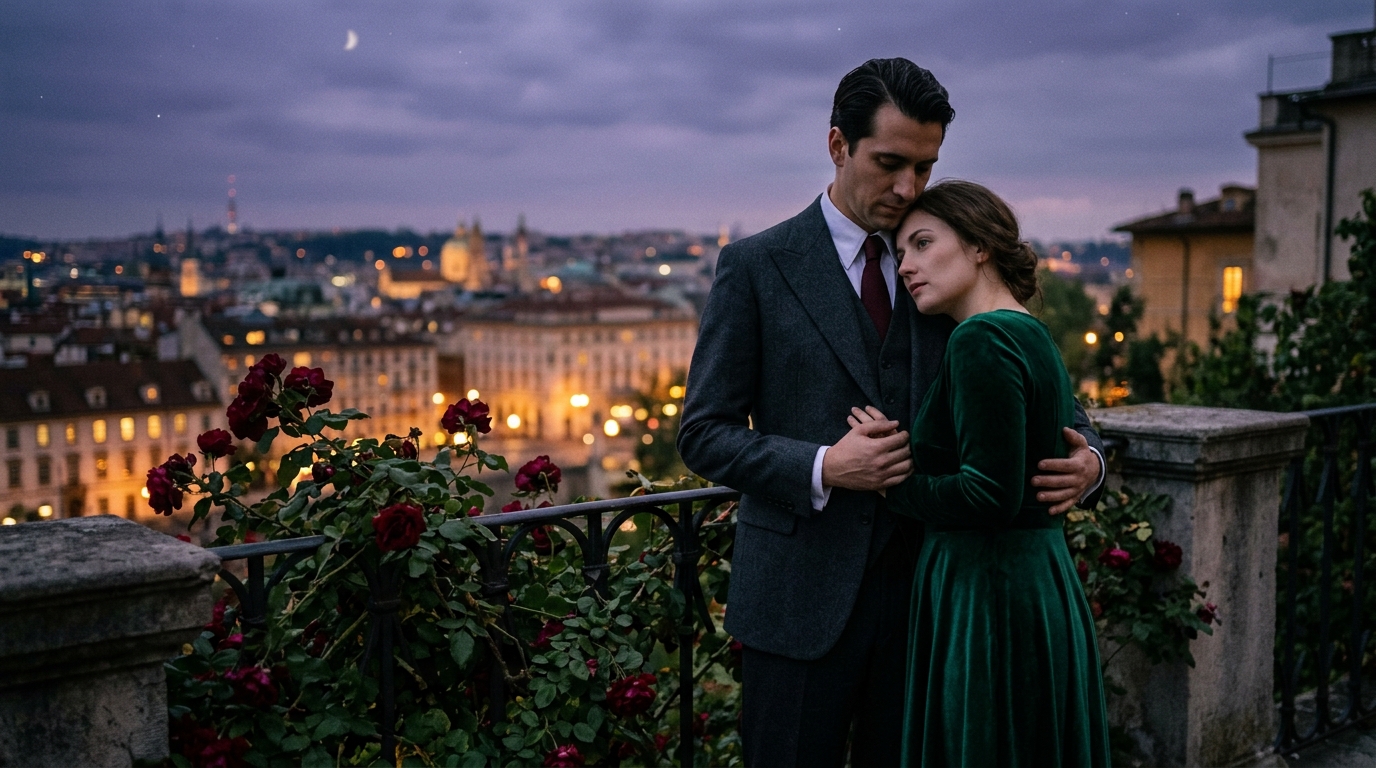

There is a precise moment in every great Dark Romance saga where the heroine’s eyelids flutter shut.
She does it as an instinct of survival. To escape reality. To pretend that what is unfolding between them is nothing more than a dark mirage. To convince herself that she despises this man, that she recoils from his touch, and that her body remains numb to the predator holding her in his grasp.
And that is when two heavy, warm, calloused hands lock with undeniable authority onto the crest of her hips.
The anti-hero closes the distance from behind, his chest pressed flush against her back, his breath searing across the curve of her temple. In the glass of a gilded full-length mirror, his dark eyes find hers.
With a firm upward tilt of his thumbs, he demands her posture straight:
“Open your eyes, sweetheart. Don’t hide in the dark. Look at yourself in the glass… and dare tell me you don’t want this.”
At that exact sentence, a collective shiver passes through millions of readers across BookTok.
Welcome to The Mirror Trope: the most sensual, ruthless, and psychologically revealing court of law in all of dark romance.
1. Shattering Denial: The Incorruptible Judge
Why are anti-heroes so fixated on Venetian mirrors, floor-to-ceiling penthouse glass at twilight, and dressing-room mirrors?
Because the mirror is the one weapon against which the heroine’s pride cannot defend itself.
For chapters, the narrative rests on her fierce internal defense:
- “I hate him.”
- “He disgusts me.”
- “My body doesn’t respond to his touch.”
- “My racing pulse is purely adrenaline and fear.”
In the dark of a bedroom or with eyes squeezed shut beneath silk sheets, the lie is easy to maintain. The mind can rationalize anything.
But under warm lamplight before a tall mirror, the courtroom of the senses delivers an unappealable verdict:
                  THE TRIAL OF THE GLASS IN THE DARK

     EYES SHUT (The Defense)                   EYES OPEN (The Verdict)
 ┌───────────────────────────┐             ┌───────────────────────────┐
 │ • Illusion of resistance  │             │ • Dilated pupils          │
 │ • Mental rationalization  │     ──►     │ • Flushed skin & throat   │
 │ • Escape into denial      │             │ • Arching spine           │
 │ • “I feel nothing at all” │             │ • Complete bodily truth   │
 └───────────────────────────┘             └───────────────────────────┘
By forcing her to look, the anti-hero is not simply seeking dominance: he strips away her last sanctuary of denial. He forces her to acknowledge that the second his mouth brushes the crook of her neck, her breathing fractures and her pupils dilate.
2. Visual Contrast: The Beast and the Shadow Queen
Aesthetically, the mirror scene is a visual masterclass of chiaroscuro lighting:
In the frame of the mirror, two opposing worlds collide:
- The Anti-Hero: Towering, broad-shouldered, sharp jawline, dressed in tailored darkness or ink. He embodies lethal control and command.
- The Heroine: Flushed, trembling, hair spilling over bare shoulders, appearing delicate yet burning with a fierce inner fire she is only beginning to understand.
That contrast in the glass creates a revelation: For the first time, she doesn’t look like an ordinary victim.
She sees the full picture: two silhouettes locked together in striking harmony. She realizes that standing beside this dangerous man, she doesn’t look helpless—she looks like a queen awakening to her own power.
3. Emancipation Through the Gaze: Owning One’s Desire
In civil society, female desire is still burdened by subtle shame, modesty expectations, or self-consciousness. Many women have never watched themselves experience raw abandon.
Here lies the psychological magic of the mirror trope: it turns the heroine into an active witness of her own pleasure.
The anti-hero uses the mirror to validate her desire:
- He does not ask her to hide.
- He orders her to admire what she feels.
- When he whispers, “Look at how gorgeous you are when you let go,” he celebrates her in her rawest, most untamed state.
The Mirror’s Lesson:
This trope is not about passive voyeurism. It is about integrating the shadow. Looking at your reflection in the arms of a dangerous man means accepting that you are allowed to crave the forbidden, free from guilt.
4. The Choreography of the Glass
                   CHOREOGRAPHY OF THE MIRROR SCENE

    [1. THE IMPACT]        Brought before the glass.
           │               She tries to shut her eyes to hide.
           ▼
    [2. THE COMMAND]       Hands grip hips / chin tilted upward.
           │               “Look at me. Open your eyes.”
           ▼
    [3. THE VERDICT]       The reflection exposes the flush of skin.
           │               Physical impossibility of denying the truth.
           ▼
    [4. SURRENDER]         She holds her own gaze in the glass.
                           Shame dissolves into unapologetic devotion.
5. Steam on the Glass: The Dissolving Frame
Like the Gala Dress or the Knife-to-Throat scene, the mirror sequence concludes with the blurring of its own frame.
As breath quickens and body heat rises, a thin mist of steam clouds the glass.
This sensory detail carries poetic weight:
- At first, the mirror provided a sharp, clinical reality check.
- In the end, heat and passion blur the edges.
She no longer needs the mirror to know what she feels. She no longer needs external proof. Her fingers slide back through his dark hair.
Denial is gone. The queen has arrived.
6. Discover the Power in Cruel Accords
In Cruel Accords — Volume 1: Under His Rule, Julian Wolfe uses reflection, posture, and unwavering eye contact to strip away Elena Vance’s defenses in his glass Manhattan tower.
Ready to dive in? Read Cruel Accords on Kindle Unlimited, and join the Zaria Vane VIP Club for exclusive author insights!